
Agentic systems need governance, not just orchestration.
OrbitWorks designs governed agentic architectures that balance autonomy, control, observability, and operational reality. Getting an agent to run is the easy part. Getting it to run safely, repeatably, and in a way you can actually audit is the work.
This practice area builds on the Security & Operations foundation, agent workflows need trust boundaries and access models before they need orchestration.
Agents inherit the security posture of whatever they are deployed on
Most agentic implementations are built for capability first and governance never. Tool access is broader than it needs to be. Logging captures what ran but not why decisions were made. Human oversight paths are either absent or treated as optional. Data handling is implicit rather than designed.
When something goes wrong, an unexpected action, a data exposure, an unintended escalation, there is no audit trail that explains what happened. That is not an orchestration problem. It is an architecture problem that starts at the security layer.
OrbitWorks designs the agent governance layer on top of the security architecture, trust boundaries, identity models, and compliance controls defined first, then agent workflows designed to operate within them.
What goes wrong in agentic systems without governance
The OWASP guidance on agentic application security identifies a consistent set of failure modes. OrbitWorks designs explicitly to address these.
Prompt injection and instruction manipulation
Malicious or unexpected input can cause agents to deviate from intended behavior. Without input validation, context scoping, and behavioral boundaries, agents can be redirected in ways the system designer never intended.
Insecure tool access and tool misuse
Agents with broad, unscoped tool access can take actions well beyond what any specific task requires. Least-privilege design for tool use is the difference between a contained failure and a system-wide incident.
Data and context leakage
Information retrieved during one task, loaded into agent memory, or passed between agents can surface in contexts where it should not. Without explicit context controls, sensitive data migrates to places that are difficult to track.
Memory poisoning and state manipulation
Persistent memory systems can be manipulated through crafted inputs that alter stored state, or through retrieval patterns that surface outdated, incorrect, or injected information as authoritative context.
Autonomous workflow abuse
Multi-step agentic workflows can chain actions that produce significant real-world effects (sending communications, modifying records, triggering downstream processes) without human review if approval paths are not explicitly designed.
Supply chain and integration exposure
Agentic systems typically integrate with external APIs, model providers, retrieval systems, and third-party tools. Each integration point is a potential exposure surface. Without explicit security review, supply chain risk is inherited silently.
Observability gaps
If agent actions, decisions, and data access cannot be traced after the fact, incidents cannot be investigated, compliance cannot be demonstrated, and trust cannot be established. Observability is a governance requirement.
The architecture layer that makes agentic systems safe to operate
Governed orchestration
Multi-step workflows with defined control points, explicit role separation between agents, and escalation logic that determines when human review is required. Autonomy should be bounded, not unlimited.
Tool-access boundaries and least-privilege design
Agents are scoped to the tools, APIs, and systems they need for the task, nothing broader. Tool permissions are explicit, documented, and reviewed as part of the architecture.
Context and data controls
Retrieval design, context window management, and memory scoping are treated as security decisions. Sensitive data should not surface in contexts where it does not belong.
Human-in-the-loop patterns
Where autonomy needs review, approval, or override, we define that path explicitly. Human oversight is designed as a first-class component of the workflow with clear triggers, routing, and response handling.
Audit trails and operational observability
Agent actions, tool calls, retrieval events, and decision points are logged in a form that supports operational review, incident reconstruction, and compliance demonstration.
Secure deployment and operational handoff
Agentic systems are containerized, versioned, and deployed with the same discipline as any production system. Secrets are managed explicitly. Operational runbooks cover the system as it actually runs.
Where governed agentic architecture applies
- Internal workflow automation handling sensitive operational data
- AI-enabled analyst augmentation in regulated environments
- Controlled knowledge and document retrieval systems for enterprise use
- Operational assistants with bounded, auditable action capabilities
- Multi-agent coordination platforms for complex delivery workflows
- Secure enterprise AI integration with existing identity and access infrastructure
- AI-enabled services requiring demonstrable governance for client or regulatory trust
What an AI Agent Architecture engagement delivers
Depending on scope, deliverables typically include:
- Target architecture covering orchestration design, agent roles, and system boundaries
- Trust and access model defining what each agent or workflow component can reach and why
- Data-flow and context review identifying exposure surfaces and retrieval risk
- Tool-access boundary design with least-privilege rationale documented
- Human-in-the-loop specification covering approval triggers, routing, and override paths
- Logging and observability design aligned to operational and compliance requirements
- Deployment architecture and environment design
- Operational runbooks covering normal operations, exception handling, and incident response
- Governance documentation suitable for internal review, client assurance, or regulatory inquiry
Standards that inform our agentic architecture work
This practice area builds on:
Platform Architecture
OrbitWorks platforms are designed with identity-first perimeters, governed routing, and cryptographically verifiable audit trails. Every model request, tool call, and agent action passes through a single inspected pathway.
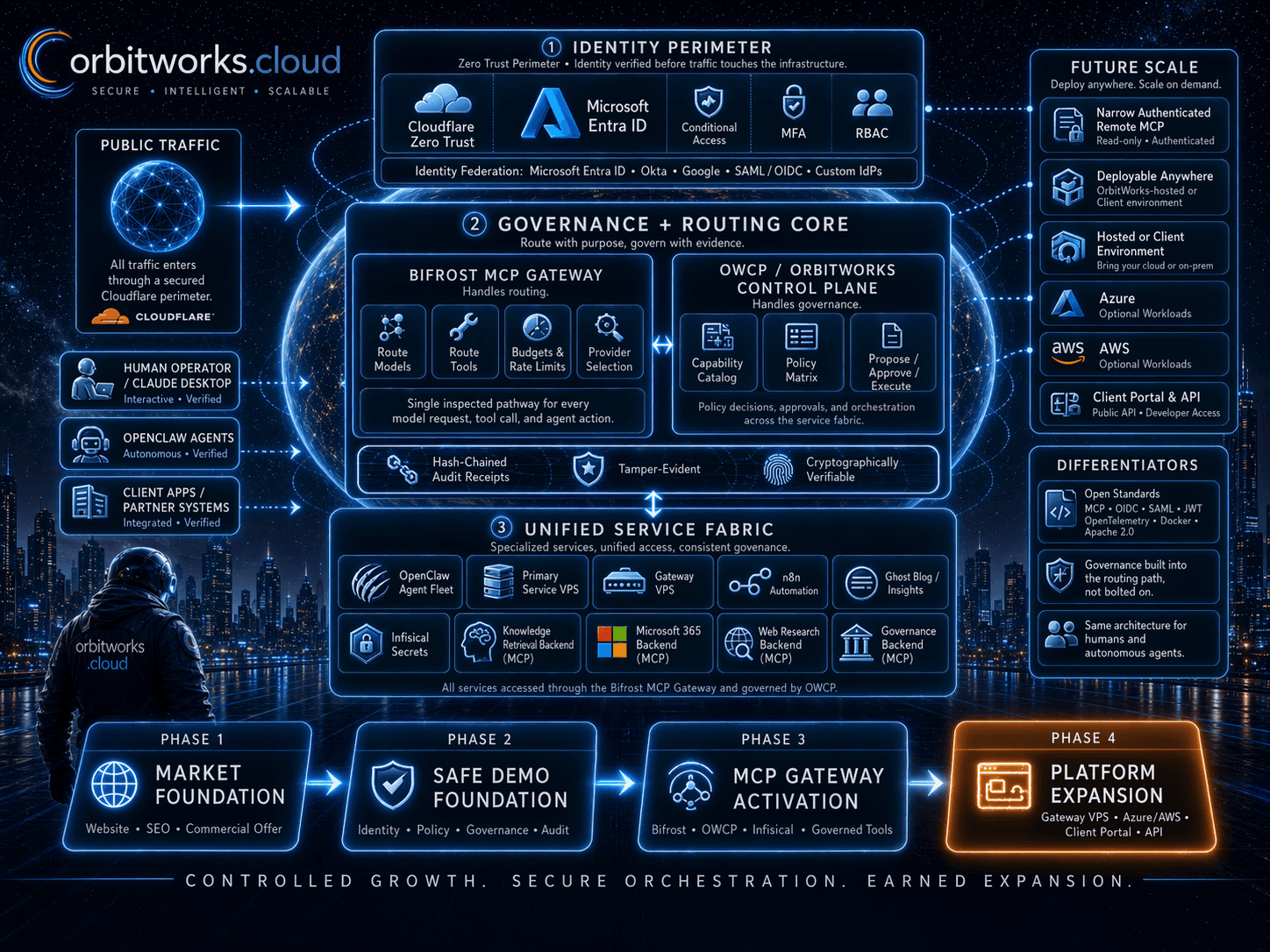
Platform Architecture — High-Level Design
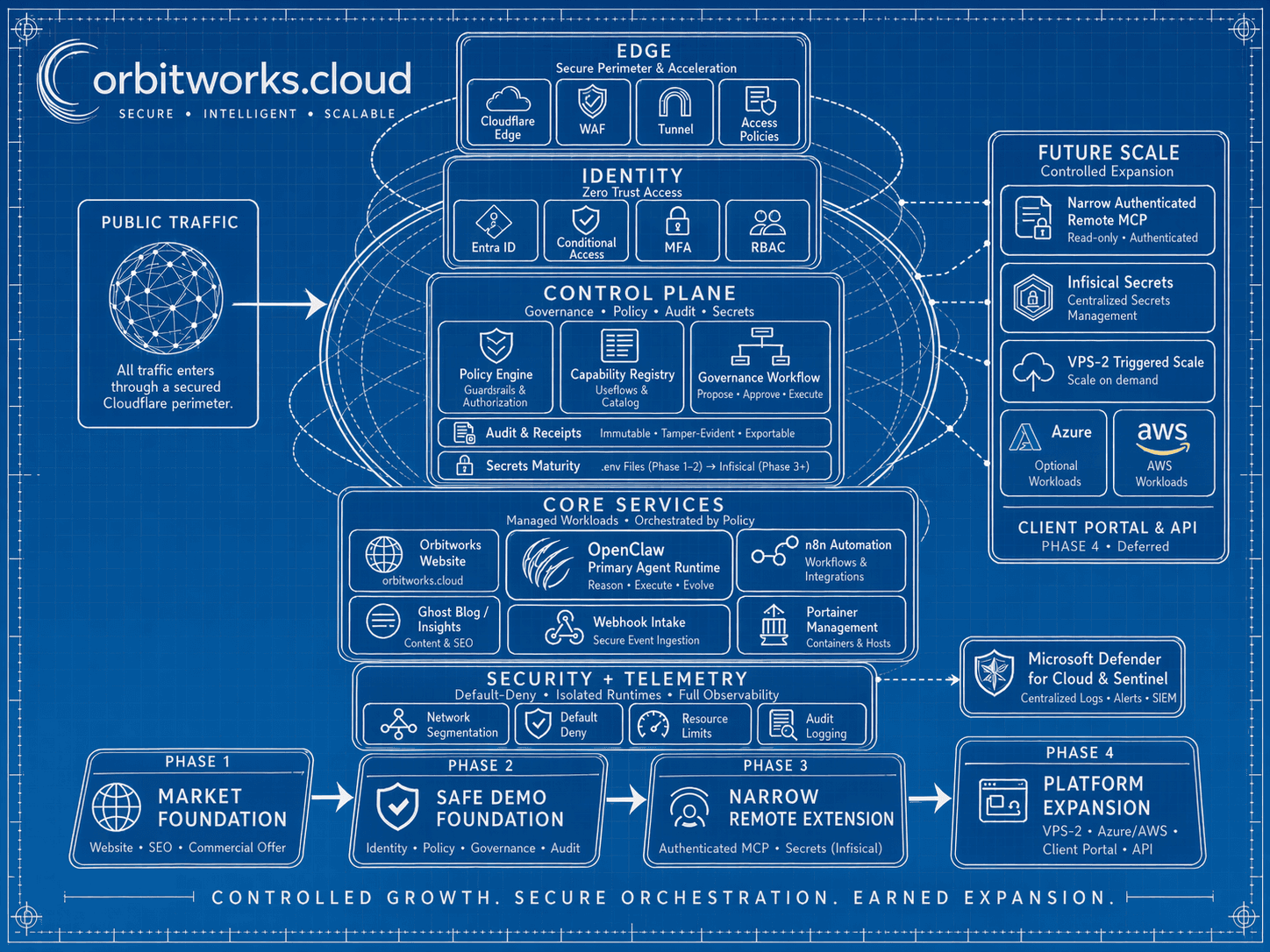
Infrastructure Blueprint
Building agentic systems without guardrails is just automation with better marketing.
If you are building AI-enabled workflows that will touch real data, real systems, or real users the governance layer is not optional. Start the architecture conversation before the build makes it expensive to add.
Discuss an AI Agent Engagement